


In the early years of St. Paul, Margo and Dieter Kuijl brought in two people to make the production process transparent. They walked through the factory and wrote everything down on rolls of wallpaper. “After two days, Dieter and I knew we had to automate,” says Margo. “At the time, automation was still in its infancy at many companies, and it has served us well.”
Looking closely at what’s in front of you and figuring out how it can be done better: that’s what inventiveness looks like at St. Paul. It’s one of our five core values, alongside family tradition, mastery, reliability and quality. And it runs through our history.
Learning from the best
Being inventive starts with curiosity. When Margo and Dieter started in 1985, they were 25 and 21 years old. “We were eager to learn and took training courses,” says Margo. One of the people they learned the most from was Dr. Berger from Ludwigshafen, producer of JOHA emulsifying salts. “He traveled the world helping processed cheese producers,” says Dieter. “Wherever he went, he corresponded with us about what he saw and learned. We received faxes from Japan, Australia and the United States. We learned the art of cheese melting from him.”
Seeing opportunities before they exist
When export refunds for European agricultural products were set to disappear, St. Paul chose a new direction: processed cheese as an ingredient for the food industry. That market was still in its infancy. Frozen pizzas hardly existed, but Dieter was already developing analogue cheese, an ingredient that would later be used extensively on frozen pizzas. It meant new machines, a different market approach and arranging our own transport within Europe.
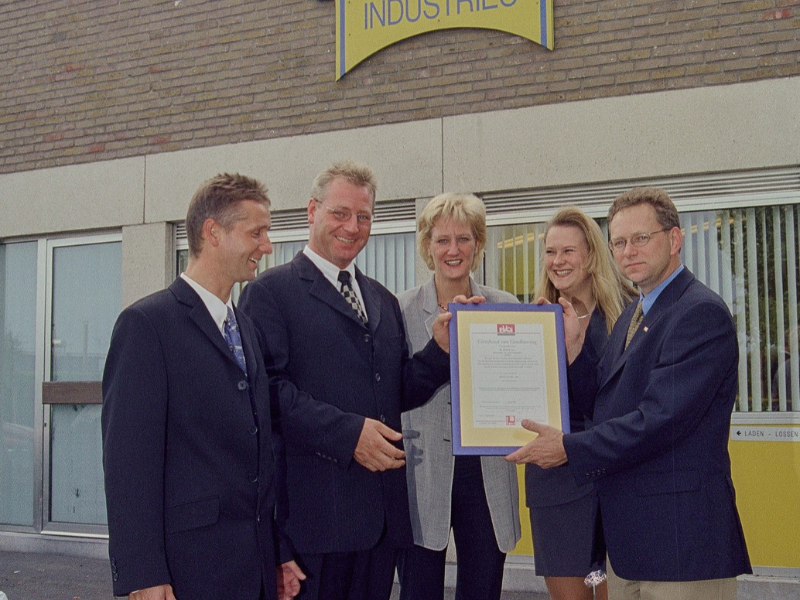
In 1997, that inventiveness was recognized: St. Paul was a finalist in the Most Innovative Semi-Finished Product Award Competition 1996/1997.
A plan of our own in a crisis
In 1999, the dioxin crisis brought Belgian food production to a standstill. St. Paul had to stop too, because all products from Belgium were boycotted. Margo and Dieter didn’t wait. They informed the Belgian and Dutch authorities of the exact date and time the first truck would drive back to the Netherlands, and provided proof that there were no Belgian products in the end product. After that, production could resume.
Together with our customers
Today, inventiveness shows most in the way we work with customers. They often come to us with an idea or a wish for a new product, and together we turn it into a recipe that works in practice. That’s also how the Souflesse came about: a cheese soufflé we developed together with Van Geloven, at the request of a customer who dreamed of wafer-thin puff pastry with a rich filling of mature cheese.
“For those who don’t work with cheese on a daily basis, it sometimes seems like magic how we adjust a recipe or process to achieve the desired result,” says key account manager Egbert van de Winckel. “In reality, it’s all about precision and craftsmanship: turning one knob and adjusting another slightly. We keep going until the product is perfect.”
Stefan Herwegh recognizes this in his work as a product developer: “You often have to be creative to find solutions for customers.”
From rolls of wallpaper to Woerden
The drive to automate never went away. In 2024, St. Paul acquired Koninklijke ERU, known for products such as ERU Goudkuipje. We’re putting our experience to work there too: St. Paul is helping to further automate the ERU factory in Woerden. “St. Paul has extensive technical knowledge of the production process that we will put to good use for Koninklijke ERU,” says Audrey van Ham, co-CEO of Koninklijke ERU.
What started with two people and a few rolls of wallpaper has grown into knowledge we now pass on.
Margo’s advice to other entrepreneurs sums it up well: “Stay true to yourself, do what you’re good at, stay focused, keep developing, and always look ahead to where the opportunities lie.”
Because the best solution usually isn’t on the shelf yet.